
Sell your collectables
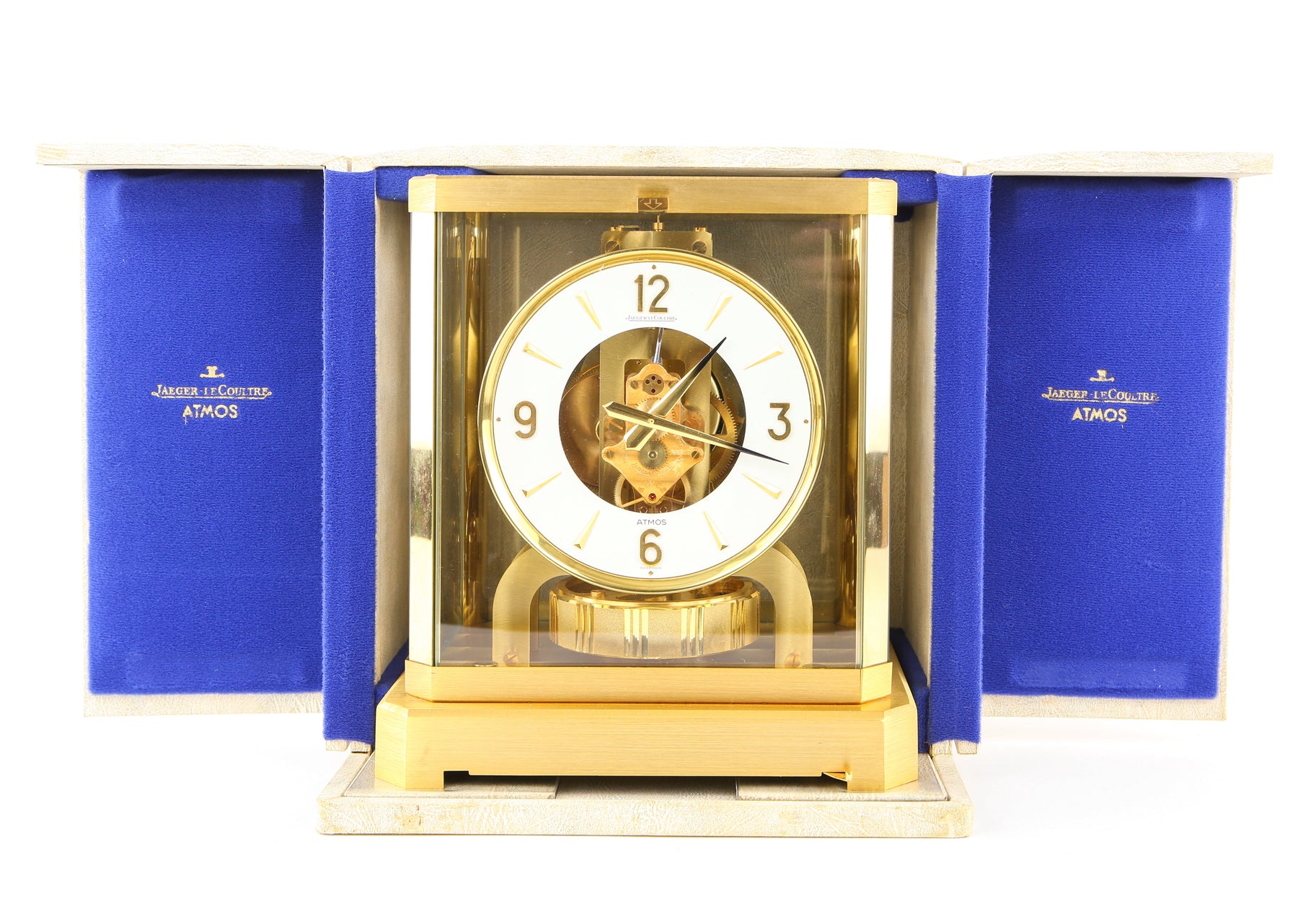
Few timepieces carry the same quiet confidence as a Jaeger-LeCoultre clock. They’re not designed to shout for attention. Instead, they sit elegantly on a mantelpiece or sideboard, turning heads with their clarity, stillness and sense of technical calm.
If you’ve ever seen an Atmos clock up close, you’ll know what makes them so different. No ticking. No winding. Just a slow, near-silent heartbeat that seems to float in time. For collectors and horology lovers, they’re more than decorative. They’re a marvel of design and engineering. Still one of the finest examples of precision timekeeping ever made.
The Atmos clock was first developed in the late 1920s, but it was Jaeger-LeCoultre who refined it and made it famous. What makes it so unique is the way it runs. Instead of a battery or mainspring, the Atmos is powered by changes in air temperature and pressure. Just a one-degree shift is enough to keep the mechanism going for two days.
This makes it one of the most efficient mechanical devices ever created. Everything is built for balance and economy. The movement uses so little energy that it would take sixty million Atmos clocks to match the energy needed to power a 15-watt lightbulb. The result is a clock that appears almost motionless. Yet it keeps time with remarkable accuracy.
No winding, no plugging in, no fuss. It just keeps going.
In 2025, the Atmos clock took a step back into the spotlight. At Milan’s Salone del Mobile, Jaeger-LeCoultre unveiled the Atmos Infinite Halo - a contemporary reinterpretation of the classic design. Displayed in an immersive, sculptural installation titled The Precision Maker, the clock was surrounded by mirrored brass and backlit glass panels that echoed the mechanism’s circular rhythms.
The event was more than just a product launch. It was a reminder that the Atmos still holds cultural weight, even a century after its invention. That same week, Jaeger-LeCoultre opened its Living on Air exhibition at the Milan Triennale Design Museum. The show explored the science, philosophy and beauty of mechanical timekeeping, with the Atmos clock centre stage. Quite literally. It was surrounded by installations inspired by breath, balance and light.
For collectors, this renewed visibility is important. It shows that the Atmos isn’t just a nostalgic nod to the past. It’s still being reimagined, studied and celebrated today.
Jaeger-LeCoultre has long held a reputation for technical mastery. The brand isn’t just known for clocks, of course. It’s a respected name in high horology, with a watchmaking history going back to 1833. The maison created the first keyless watch, the world’s smallest movement, and the famous Reverso watch, originally designed for polo players in 1931.
More recently, it’s become known for its jump hour watches, a style that’s seeing a revival in 2025. These watches tell time through rotating discs that ‘jump’ from one hour to the next, rather than with traditional hands. It’s another example of Jaeger-LeCoultre’s commitment to functional innovation paired with refined design.
Yes, Jaeger-LeCoultre still produces Atmos clocks, including new limited editions and art-led collaborations. Recent models include the Atmos Transparente, the Atmos Régulateur, and now the Atmos Infinite. Each is assembled by hand at the company’s workshop in Le Sentier, Switzerland. The same valley where the brand began almost two centuries ago.
The fact that the Atmos is still made today, using traditional techniques and modern precision, is part of its appeal. You’re not just buying a beautiful object. You’re investing in a legacy of craftsmanship.
With care, an Atmos clock can last for generations. Many collectors own pieces from the 1950s or earlier that still work perfectly today. Because the mechanism is sealed and so energy-efficient, wear and tear is minimal. But they do still need to be serviced every 20 to 25 years by a specialist.
They’re not difficult to care for, but they do need a steady environment. Avoid placing them near radiators or in direct sunlight, and don’t try to move them too quickly. The internal bellows are sensitive, and the clock should be level to keep good time.
And no. You don’t need to wind them.
Original Atmos clocks, especially early models or rare variants, have seen steady growth in value over the past decade. Collectors look for good condition, original glass, visible serial numbers and working mechanisms. Special editions or those with presentation cases can command premium prices.
But like most Jaeger-LeCoultre timepieces, the real value goes beyond price. These are objects made with care, designed to last, and created for people who appreciate understatement and ingenuity. Whether you’re placing one on a study shelf or gifting it to mark a special occasion, an Atmos clock is a serious choice. But a deeply rewarding one.
If you own an Atmos clock and are curious about its value, we can help. We offer free quotations to sell your Jaeger-LeCoultre clock in good condition. We also have a carefully selected range of Jaeger-LeCoultre clocks for sale, including Atmos models, all checked for authenticity and working order.
Whether you’re collecting, gifting, or simply want to own something quietly extraordinary, these clocks offer something very few objects can. Permanence, elegance, and just the right amount of wonder.


